Why a Refrigerant Recharge Is Not Enough for a Classic Car AC?
It is a common scenario in the world of classic cars when the cabin becomes unbearably hot in the summer heat, and it turns out that the AC is barely cooling. In such cases, most owners first think of quick help: they pull into the nearest workshop for a simple recharge. However, experience shows that recharging a classic car’s AC alone rarely helps. On an older car, a quick fix does not solve the underlying problem; in fact, it can even cause fatal mechanical damage to rare components.

Why is recharging a classic car’s AC without leak detection an illusion?
A motor vehicle’s air conditioning system forms a closed loop. Under normal conditions, the refrigerant never runs out on its own. If system pressure has dropped, the refrigerant has inevitably escaped somewhere. On a thirty- or forty-year-old vehicle, there are countless weak spots where the refrigerant leaks out unnoticed.
Over the decades, rubber AC hoses develop microscopic cracks. Conical or O-ring rubber seals at pipe connections age over time and let refrigerant pass through. The condenser located in front of the engine radiator can get punctured by stone chips and corrosion. In addition, the compressor shaft seal also wears out regularly, especially if the air conditioning has not been operated for years.
In this condition, a simple refrigerant recharge is a waste of money. Without thorough leak detection and seal replacement, the fresh refrigerant escapes quickly. The root of the problem remains in the system, and on the next hot weekend, your classic car is left without working AC again.
Why can mixing new refrigerant with old oil destroy the compressor?
Before the mid-1990s, classic car AC systems were factory-filled with the period R12 refrigerant. This refrigerant was banned decades ago due to its high ozone-depleting potential. However, modern refrigerants used in workshops today (such as R134a) must not simply be recharged into old systems.
The greatest technical hazard lies in the incompatibility of lubricating oils. The compressors of old R12 systems used mineral-based oil. Modern refrigerants, however, can only operate properly with modern, synthetic lubricants; only with these synthetic oils are they able to circulate adequately through the AC loop.
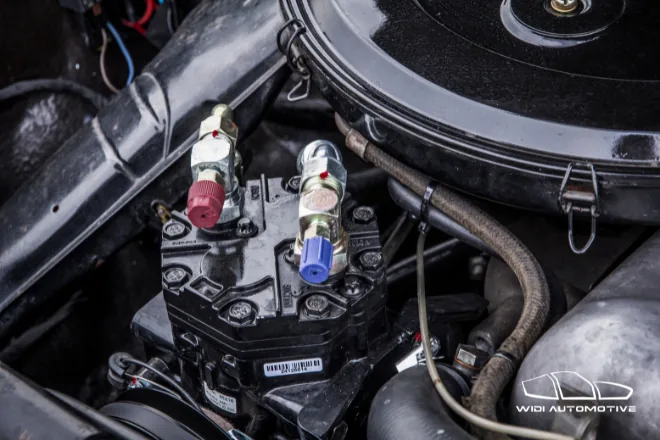
Without thorough internal cleaning, the mineral oil remaining in the system cannot mix with the R134a refrigerant, meaning the refrigerant flow will not carry it back to the compressor. The lubricant can become trapped in the evaporator and condenser, leaving the compressor unlubricated, while residual chlorine and moisture can trigger acidification and sludge formation.
How does professional classic car AC restoration take place?
For durable cooling performance, the AC circuit must be adapted to modern requirements. In our workshop, the classic car AC restoration process is built on well-thought-out engineering steps:
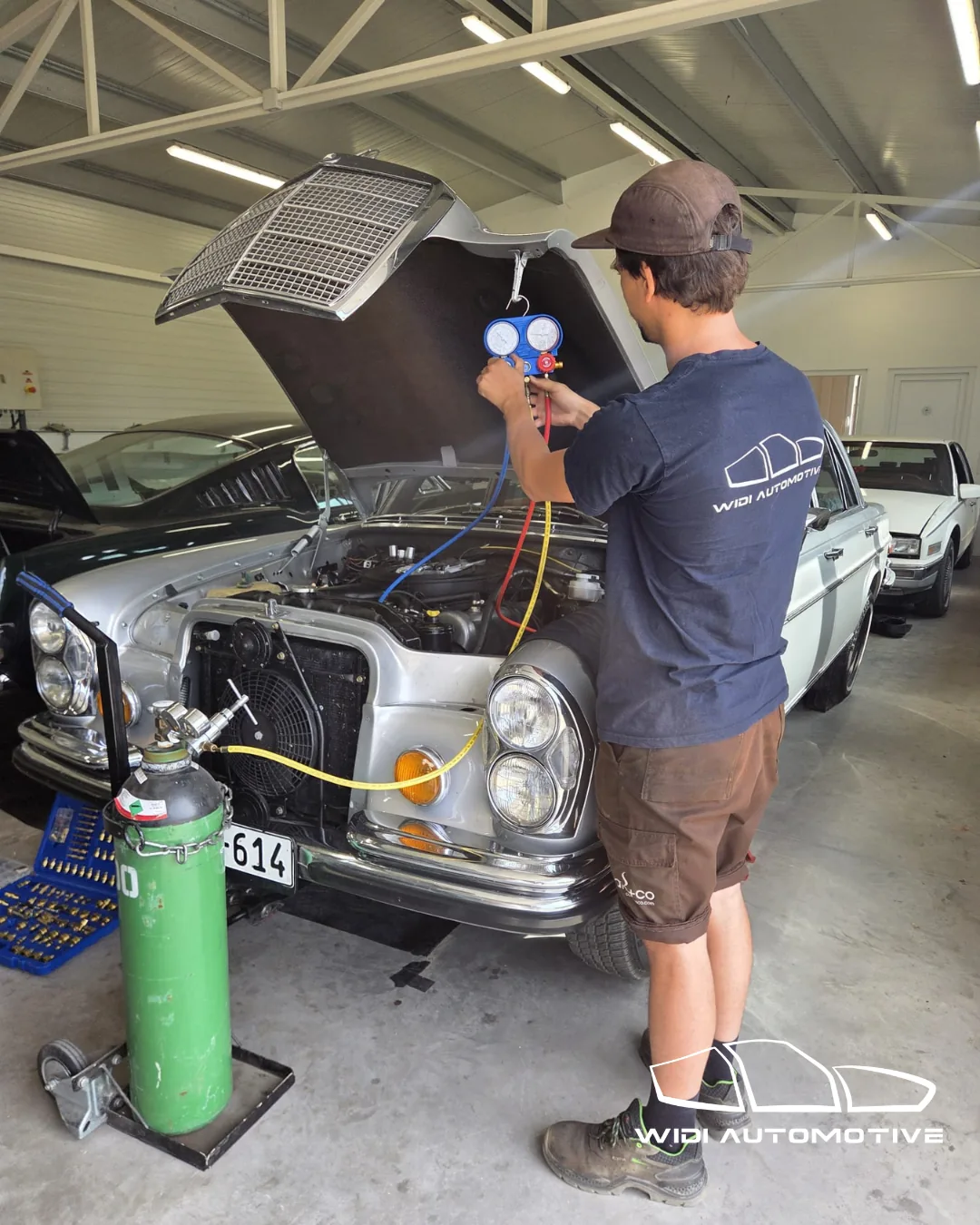
- Professional recovery and disposal of the previous refrigerant: First, we recover the old refrigerant remaining in the system. The recovered refrigerant is handled according to applicable regulations and, where necessary, handed over to authorized specialist contractors for disposal. Thus, apart from minimal technological losses, no harmful substances enter the atmosphere.
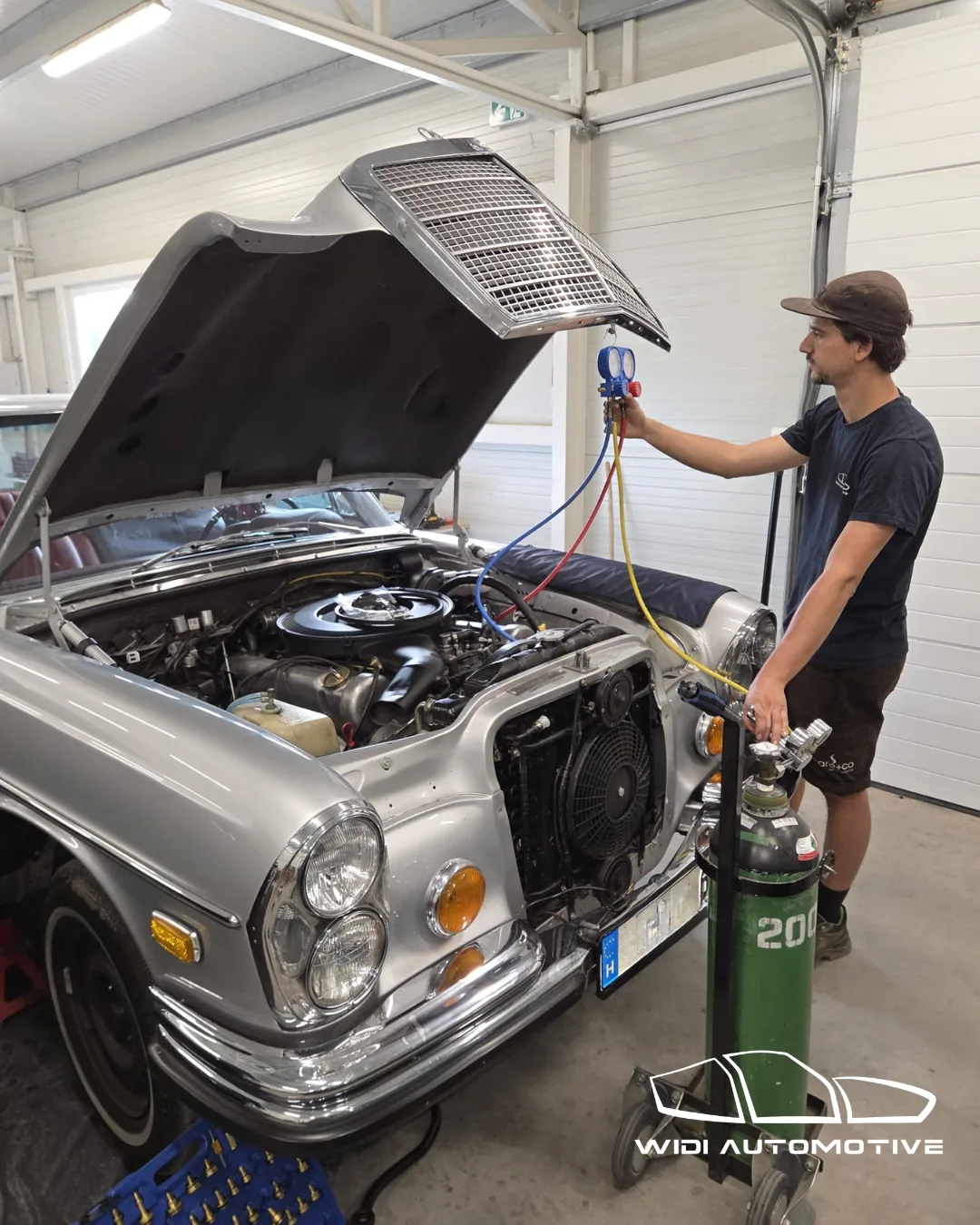
- System diagnostics, pressure testing, and electrical inspection: We pressurize the AC loop with dry nitrogen gas to inspect structural integrity and reveal leaks at lines and heat exchangers. In parallel, we carry out a comprehensive inspection of the electrical system, checking the auxiliary fans, switches, temperature controls, and blower vents.
- Partial disassembly and internal flushing of pipework: We disassemble the AC circuit into components in the workshop. We completely flush the pipework and heat exchangers with dedicated flushing fluid to remove deposited old mineral oil residues and contaminants. We remove the AC compressor and thoroughly drain the old oil from it.
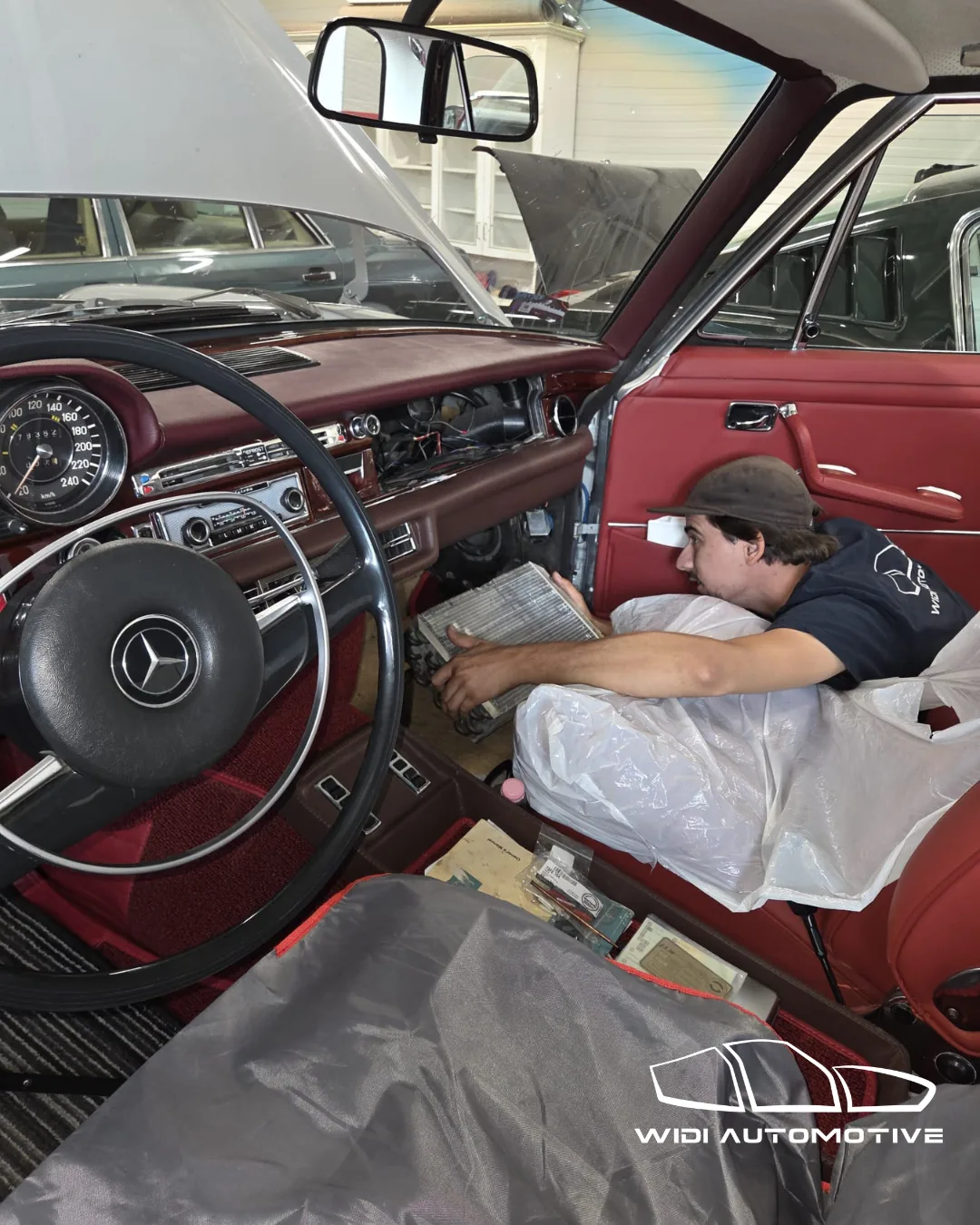
- Replacement of the receiver drier and expansion valve: We replace the receiver drier in every single case, as the old desiccant material becomes saturated with moisture, degraded oil, and metallic wear debris. We also replace the expansion valve with a type calibrated to the pressure and flow characteristics of the new refrigerant.
- Installation of modern, gas-tight seals and new barrier hoses: We install new, modern seals at all system connection points. Aged rubber lines are replaced with modern multi-layer barrier AC hoses designed to retain smaller HFC molecules.
- Professional overhaul of the vintage AC compressor: If an original factory compressor cannot be sourced as new, we rebuild the existing unit. It receives new internal seals, precision bearings, and a shaft seal, followed by filling with synthetic oil suited to modern refrigerants.
- Long-term pressure testing and deep evacuation: We pressurize the restored system again with high-pressure nitrogen gas. We maintain this pressure for at least 24 hours to monitor system tightness and identify any potential micro-leaks. Following this, prolonged vacuuming thoroughly removes all remaining moisture from the system.
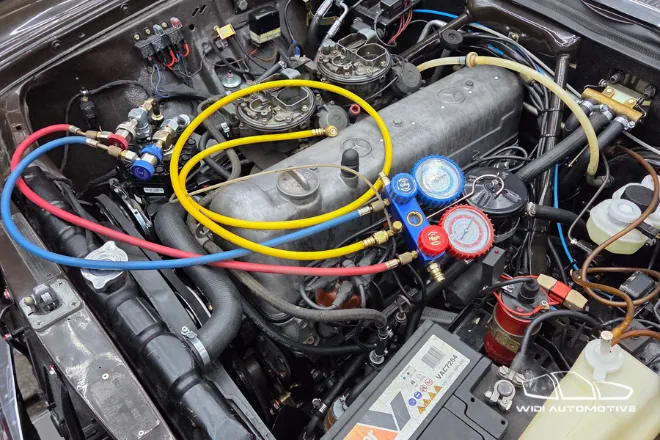
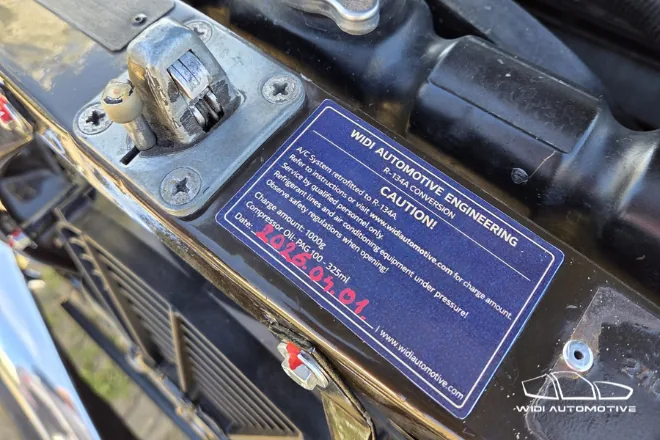
- Precision refrigerant charging and fine-tuning: We fill the evacuated system with a precisely metered refrigerant charge. A different mass of R134a is required compared to the original R12. It is forbidden to charge the original R12 weight: R134a typically requires approximately 75-85% of the original mass, as overcharging can cause dangerously high head pressures, drive system overload, and compressor damage due to liquid slugging.
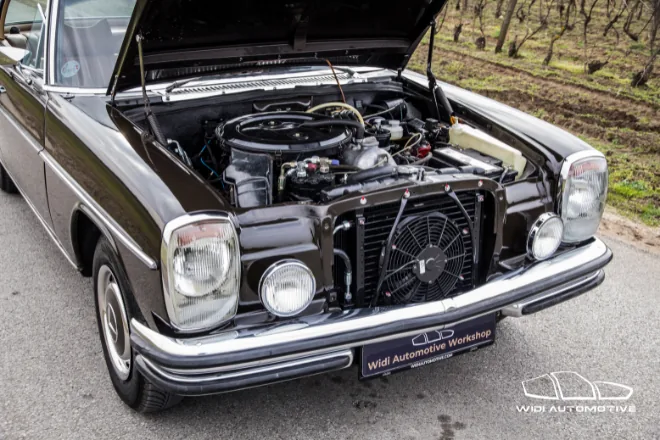
- Balancing engine cooling and auxiliary ventilation: We check the operation of both the AC condenser and the coolant radiator. The condenser is located directly ahead of the radiator and releases substantial heat into the incoming airflow. Insufficient airflow causes poor AC efficiency and leads to an overheating engine. Where necessary, we integrate a modern auxiliary electric fan to secure steady airflow.
- Road test and instrumented efficiency check: At the end of the process, the car is tested both stationary and under actual driving conditions. We take calibrated instrument measurements of vent discharge temperatures and operating pressures. We deliver the vehicle only when stable cooling is verified even in extreme heat.
Learn in detail how our classic car air conditioning restoration and modernization service works!
What to do if the classic car’s engine overheats when running the AC?
It is a common phenomenon when creeping along in traffic jams that the classic car’s engine begins to overheat when the AC is running. The coolant temperature gauge creeps dangerously close to the red mark. Often, the issue is not with the AC unit itself, but with the lack of balance between the two systems.
Driving the AC compressor puts a noticeable mechanical load on the engine, increasing internal heat generation. Furthermore, the AC condenser is located directly in front of the engine radiator. When the air conditioning operates, the condenser releases a substantial amount of heat. Consequently, the radiator fins receive preheated air rather than fresh ambient airflow. At low speeds, without sufficient ram air, the coolant can quickly reach boiling point.
At Widi Automotive, we treat air conditioning repairs in complete unison with the engine cooling system. We thoroughly inspect the radiator, fan clutch, and fan blades. When necessary, an auxiliary electric fan is installed to support airflow. Following a coordinated overhaul, the cabin stays pleasantly cool while engine temperatures remain stable even in dense traffic.
Before heading out in the summer heat, uncover your car’s hidden mechanical risks. Choose our engineering-focused classic car pre-purchase inspection and diagnostics, or contact our specialist workshop with your questions.